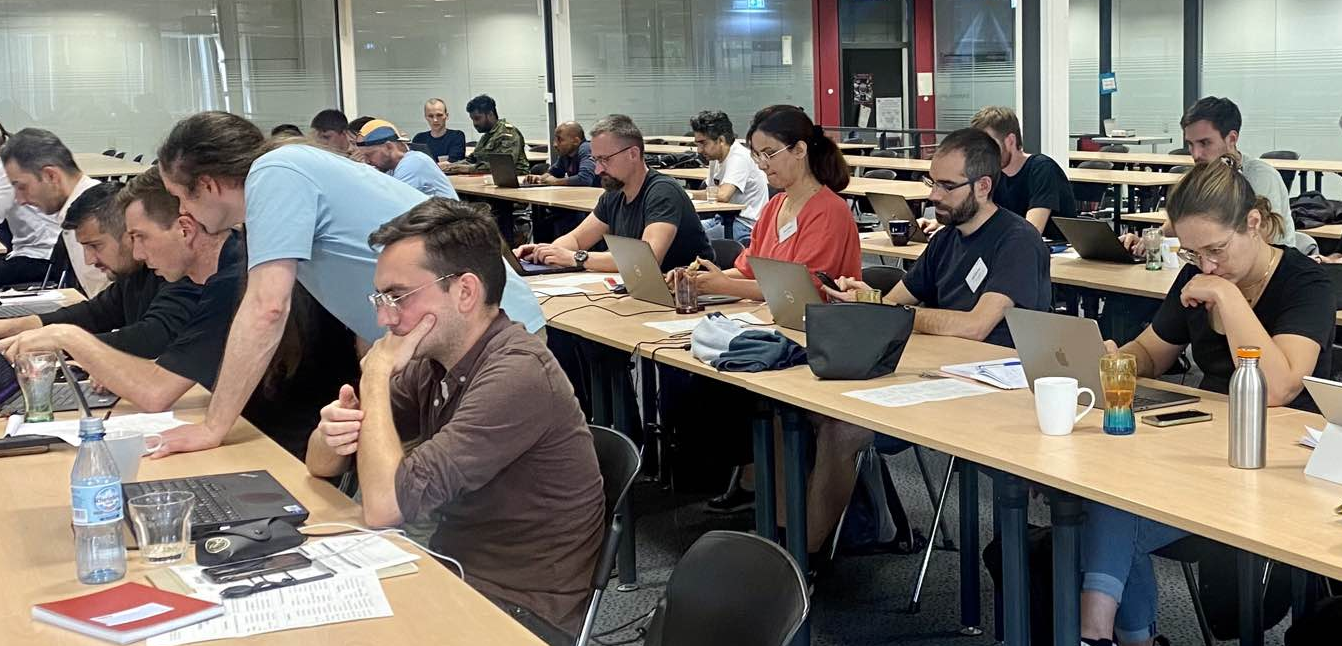
From October 16 to October 17, 2025, the HPC@HSU Workshop took place at the Helmut-Schmidt-University / University of the Federal Armed Forces Hamburg (HSU/UniBw H), organized by the hpc.bw project. The event represents the third part of HSUper workshop series for knowledge and competence transfer in the field of HPC. While the first two workshops strongly focused on the transfer of knowledge between HPC experts within the hpc.bw project and researchers in the field of HPC, this year’s workshop centered on networking and exchange about similar research challenges resp. questions through peer groups. Moreover, the workshop HPC@HSU conceptually combined offerings for self-organized learning with direct support from experts for joint problem-solving within the research projects. A total of 19 participants and 9 experts took part in the workshop.
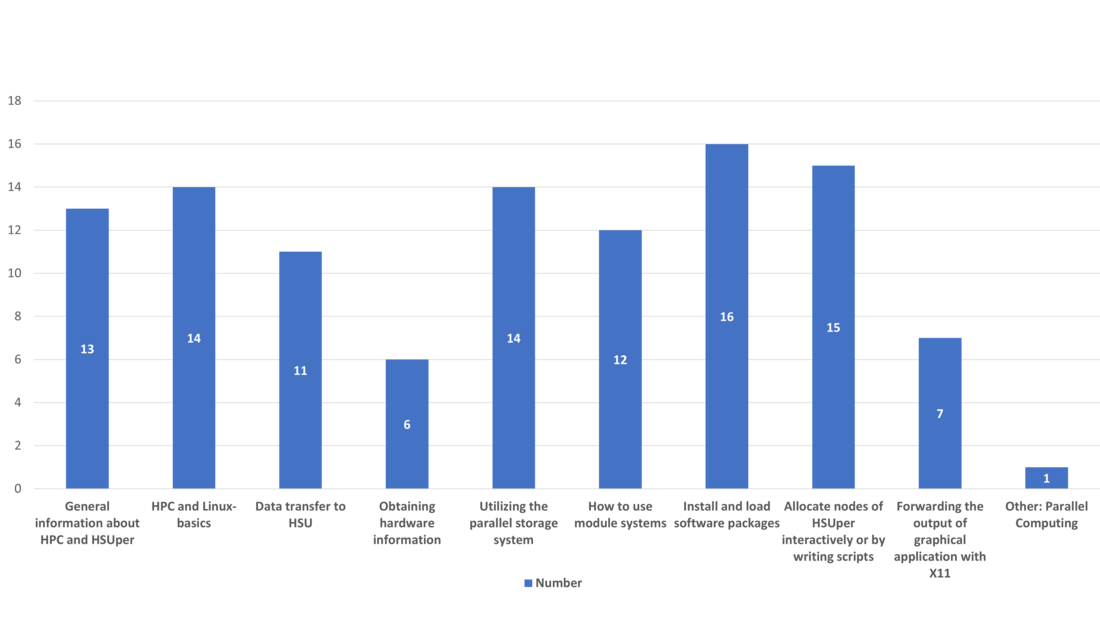
The first day began with a short joint introduction to the workshop concept, including welcome remarks by Head of HPC Lab Piet Jarmatz, followed by an introduction to the new self-learning offers (E-trainings) on the digital HPC Portal. In addition to the E-trainings already available on topics such as A short introduction to HSUper and the Linux Terminal, Data Transfer and System Resources, or Module Systems and Slurm Jobs, the following topics were newly added onto the HPC Portal:
Participants on site were accompanied by experts who could support them while working on the E-Trainings individually selected to their own need. The goal was to provide participants with access to an offer suited to their respective competence level, including appropriate support. During the last block on the first day, all participants then had the opportunity to prepare their own research projects and, with the help of a profile sheet, structure them in a way that enabled shared exchange in small groups and active work on their own project.
The second day began with the group formation. We assigned the groups based on a self-assessment of HPC competences completed during registration, as well as the goals, methods, and discipline specific background of the participants’ research projects. The groups were clustered with regards to the following thematic categories:
The self-assessment combined with the information about the participants’ individual research projects helped the experts on the hand to adapt to the individual and various needs of the group members and on the other hand, to provide support where the researchers were currently facing challenges. The goal of this procedure was to support the researchers in such a way that they would be able to continue working independently on their projects after the workshop.
However, during the workshop, a shared structure was also created based on the learning management system MS Teams, which aims to provide new users of the HSUper and generally interested researchers with a long-term opportunity for exchange within the peer group. The day ended with a joint reflection and evaluation of the workshop. The participants clearly expressed their need for a regular workshop with the same setting and gave the workshop positive feedback.
Of all participants who took part in the evaluation (n = 13 / N = 19), 75% stated that they agreed or strongly agreed with the statement “The workshop helped me deepen my understanding of HPC.” Another 82% agreed with the statement “The workshop helped me make progress in my own project,” and 92% would agree with “I will use the offers on the HPC Portal in the future.” While these ratings only provide an indication of the participants’ satisfaction with the workshop concept, they are already an important indicator that the goals we set for the workshop have been achieved. The exploratory setting, with alternating phases of self-organized learning processes and peer-to-peer group formation, seems to have been well received and offers potential for providing direct support in the implementation of research projects, rather than merely transferring knowledge. Additionally, the evaluation identified further topics that could be made available as E-trainings on the HPC Portal, e.g. working with the programming languages R and Julia. Furthermore, the feedback collected will help to further optimize the concept for the next event. Based on this feedback, we will change the first day from an overall open to a slightly more scheduled and guided concept with small inputs to support the self-organized learning experience. We will also focus on ensuring more opportunities for exchange between the groups and experts, to identify challenges and the resources to tackle them efficiently.